


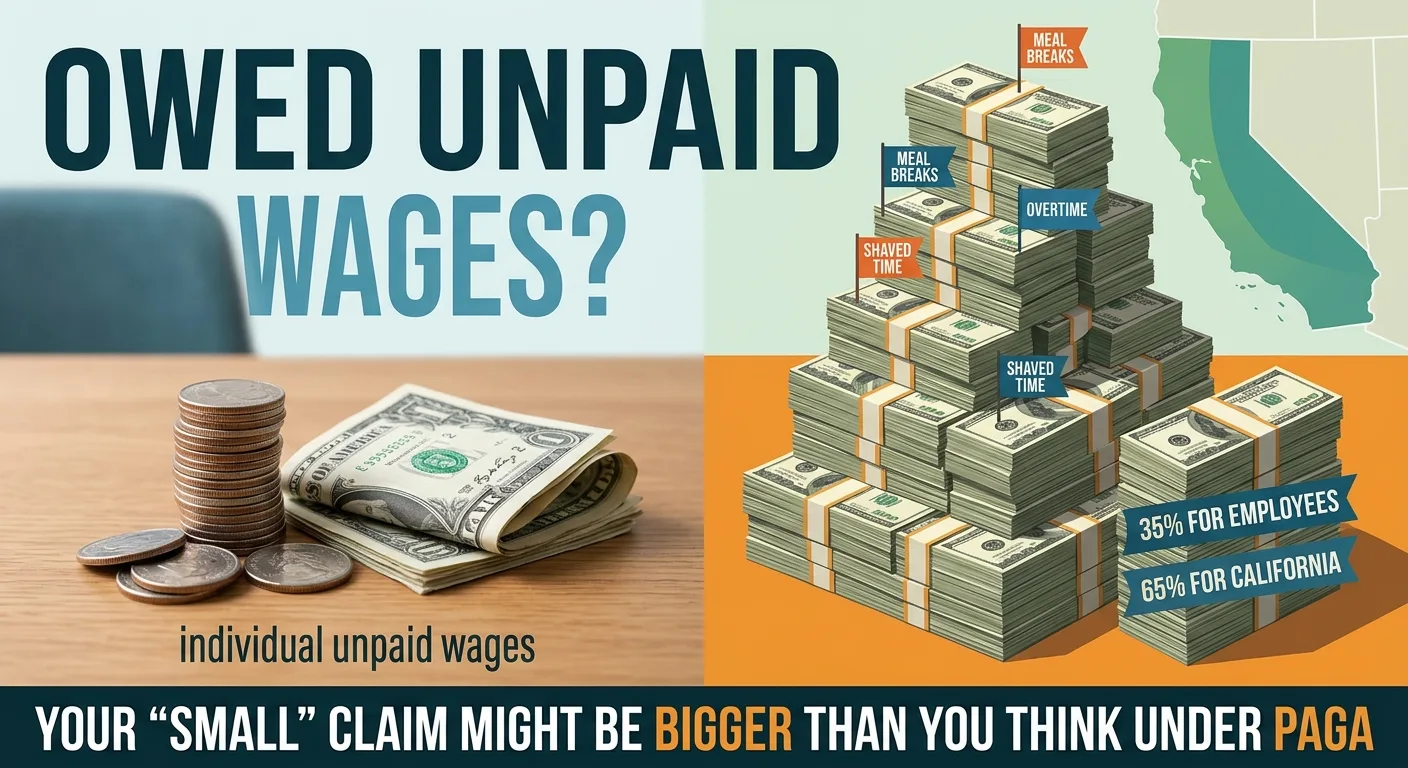
You have been working hard, but you recently realized your employer has been shaving time off your clock, denying you proper meal breaks, or failing to pay you for overtime. You add it up, and the missing pay comes out to a few hundred or maybe a couple of thousand dollars.
When you start Googling what to do, you might hit a wall. Many attorneys are hesitant to take on an individual lawsuit for a small amount of unpaid wages. The harsh reality is that the time, effort, and cost required to fight a company in court can easily outweigh a small potential recovery.
But if you work in California, you have a powerful protection on your side: the Private Attorneys General Act, commonly known as PAGA.
What is a PAGA Case?
PAGA is a unique California labor law that allows an employee to step into the shoes of the state government. By filing a PAGA claim, you act as a proxy or representative for the state’s labor law enforcement agency.
Essentially, if your employer violates the California Labor Code, PAGA allows you to file a civil lawsuit to recover financial penalties—not just for the violations committed against you, but on behalf of all your current and former coworkers who suffered the same violations.
The PAGA Advantage: Class-Action Power Without the Class-Action Burden
If you are suing an employer on behalf of a large group of coworkers, you might assume you have to file a traditional “class action” lawsuit. Traditional class actions are notoriously difficult, time-consuming, and expensive to win. To even get the case off the ground, employees must prove strict legal requirements to formally “certify” the class, which includes proving to a judge that the lawsuit is easily manageable.
PAGA completely bypasses these heavy burdens. Because a PAGA claim is legally an enforcement action brought on behalf of the government, rather than a traditional collection of individual claims, you do not have to meet the strict certification requirements of a class action.
In fact, the California Supreme Court recently ruled that trial courts cannot throw out PAGA claims simply because they might be complex or difficult to manage. This is a game-changer for employees. It means you can bring class-action-style claims with much less legal red tape. Even if your personal unpaid wages are relatively low, you can hold your employer accountable for the penalties owed to your entire workforce, giving you massive leverage and making it much easier to justify hiring an attorney.
How the PAGA Process Works
Before dragging an employer into court, PAGA requires you to follow a specific process. First, the employee (usually through their attorney) must file a written notice online with the California Labor and Workforce Development Agency (LWDA) and send a copy to the employer via certified mail.
This notice details exactly which labor laws the employer broke. If the state agency declines to investigate the issue itself within a set timeframe (usually 60 days), you are given the green light to move forward with your lawsuit.
Where Does the Money Go?
Because you are acting on behalf of the state of California, the civil penalties collected in a successful PAGA lawsuit are shared with the state government. Under the law, 65 percent of the recovered penalties go to the LWDA to help fund further labor law enforcement and educate employers and employees about their rights.
The remaining 35 percent is distributed directly among you and the other aggrieved employees who were affected by the employer’s labor violations.
While you share the penalties with the state, the ability to stack up penalties for every violation committed against every employee per pay period quickly adds up. This transforms a “too small to fight” wage claim into a significant enforcement action that employment attorneys are often eager to take on.
The Bottom Line
If you are missing wages, do not assume your case is too small to matter. California created PAGA specifically to ensure that employers cannot get away with widespread labor violations just because individual workers cannot afford to sue. By allowing you to join forces with your coworkers and act on behalf of the state without the heavy burden of a class action, PAGA levels the playing field for California workers.